

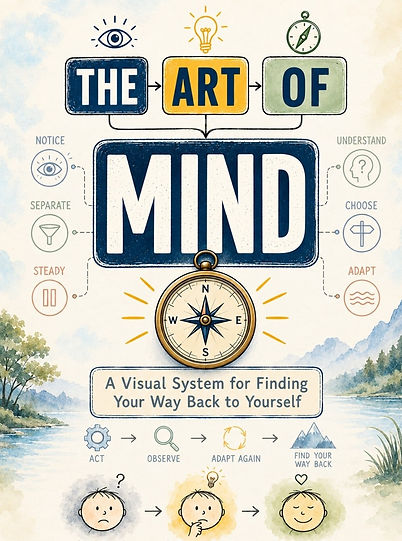
About the book
The Art of Mind is a practical, highly visual guide to understanding what happens between an event and the way we respond to it.
The book grew from a deeply personal period of reflection.
Instead of trying endlessly to understand another person’s mind, I began asking a more useful question:
'What can I do about me?'
That question became the foundation of The Art of Mind.
Through simple flowcharts, illustrated thought loops, practical questions and short exercises, the book explores how thoughts become stories, emotions become impulses and assumptions can begin to feel like facts.
But this is not simply a book about romantic relationships.
The same patterns appear in families, friendships, workplaces, social situations and online. They appear when we hear gossip, when somebody does not reply, when circumstances change, when we are tired, when social media seems to confirm our fears, or when we simply do not know what will happen next.
The Art of Mind is about creating a little more space between what happens and what you do about it.
It is not about becoming permanently calm or suppressing emotion. It is about noticing what is happening, separating fact from interpretation, understanding what you can control, adapting to what you cannot, and choosing a response that better reflects the person you want to be.
You do not need to become somebody else.
You simply need to keep finding your way back to yourself.
- • A visual system for slowing emotional reactions and making more considered choices.
• Learn to separate facts, feelings, assumptions and the stories your mind creates around them.
• Explore relationships, work pressure, gossip, social media, uncertainty, change and everyday emotional triggers.
• Practical flowcharts, illustrated loops and simple exercises make complex thinking easier to understand and use.
• Draws together mindfulness, critical thinking, psychological principles and Taoist ideas of adaptation without becoming clinical or overly spiritual.
- A practical illustrated guide to clearer thinking, emotional awareness and everyday mental adaptability.
- Slow the reaction, question the assumption and make choices that lead to better outcomes.
- For anyone who overthinks, reacts too quickly or wants more perspective in relationships and everyday life.
If you've already read it, leave a review.
About the Author
Mark McIntyre

Mark McIntyre is a writer and independent publisher interested in the ways people think, react, communicate and adapt to change.
The Art of Mind grew from a period of personal reflection in which Mark began examining his own reactions following the breakdown of an important relationship. Rather than attempting to diagnose or explain another person, he began looking more closely at his own assumptions, emotions, decisions and patterns of thought.
That process developed into a wider visual system
Click image for author page
view the gallery


keywords
mindfulness, overthinking, emotional regulation, self-awareness, relationships, relationship communication, critical thinking, personal growth, emotional intelligence, coping with uncertainty, social media wellbeing, stress management, rumination, decision making, mental clarity